Friday, October 13, 2017

Particles and Antiparticles, a mathematical difference.

The discovery of antiparticles was a revolutionary event in physics and now we are capable to produce and analyze antimatter.

We are usually told that the world of antiparticles is like an exact copy of ours but with some peculiarities. The lack of evidence of large quantities of antimatter in the observable universe is an indication that the symmetry between particles and antiparticles is not perfect. However, from a mathematical perspective it is possible to argue about a significant asymmetry between particles and antiparticles.

Group theory tell us that the Dirac spinor is a double cover representation of the Special Lorentz Group denoted by SO(1,3). This group has a subgroup characterized for maintaining the direction of time. As a result, the operations in this group can be visualized as either spatial rotations or boosts of velocity. In other words, this subgroup has a simple and intuitive interpretation and can be associated with particles. Therefore, antiparticles are the complement of the total group with the subgroup of particles. This mathematical construction is called coset. Consequently the world of pure particles has the structure of a group while the world of pure antiparticles has the structure of a coset!

This argument can be illustrated in the following diagram where O_{+}(1,3) is the group that maintains the direction of time.


The book that contains a detailed description of the group structure of spinors is

* Pertti Lounesto, Clifford Algebras and Spinors, Cambridge University Press, May 3, 2001


Saturday, October 7, 2017

Bounded states in a linear potential

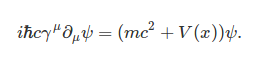
The Dirac equation with interaction in the mass is


In this case the potential does not correspond to an electric potential, nevertheless, it is often used in the literature. Something that may initially look surprising is the fact that this type of interaction supports bounded states for monotonically increasing potentials as shown in the figure below


This has been reported in the literature for sometime but without much of an explanation. The deeper insight came from the study of the Dirac equation in solid state physics where this type of system was recognized as the result of the contact of two topologically distinct phases: one with positive mass and the other one with negative mass. This contact gives origin to the so called zero mode states that have many interesting features and are the subject of intensive research today.

I published a generalization of this bounded state with additional nonlinear interactions in my recent paper at PRL

https://journals.aps.org/prl/accepted/14070Y2cTa61f86ba97d95a1f5d388e103887cbff


Wednesday, September 20, 2017

Relativistic electron in a strong laser field: Quantum spreading


Following the previous post about a relativistic classical particle in a laser field, here we have the quantum version where the center of the wavepacket still follows the classical trajectory.


This movie corresponds to a weak relativistic electron interacting with a laser field. The laser wavelength is 800 nm with an intensity of 10^20 W/m^2. The propagation follows the  z direction. The electric field is polarized along the x direction where the oscillation is observed.

As we can clearly see, the wavepacket spreading is significant even in a single oscillation!  Of course, this information is absent in the classical model.

A second animation is shown below for a stronger laser field


Thursday, August 31, 2017

Relativistic classical electron in a laser field


A particle in a laser field with fixed direction and infinite wavefront has analytic solutions in both the quantum and classical realms.
These solutions allow for the possibility of electromagnectic wavepackets modulated in the direction of motion.
 
The quantum solution of the Dirac equation was found by Volkov in the early days of quantum mechanics!

Volkov D M 1935 Z. Physik 94, 250

Contrary to expectations, the classical solutions appeared much later. The following book contains a very complete analysis of the classical case

Electrodynamics: A Modern Geometric Approach (Progress in Mathematical Physics) by William E. Baylis, Birkhäuser; Corrected edition (January 12, 2004)

The trajectories for linear and circular polarization can be seen in the following movies:

Linear polarization


Circular polarization


An interactive Mathematica cdf document can be downloaded from
http://www.princeton.edu/~rcabrera/Volkov_LinearPolarization.cdf

The general theory is part of the lectures notes at
https://github.com/cabrer7/Lectures-On-Relativity

News: The case with linear polarization was published at the Wolfram Demonstrations Project:

Renan Cabrera"Classical Relativistic Particle in a Linearly Polarized Laser Field"
 http://demonstrations.wolfram.com/ClassicalRelativisticParticleInALinearlyPolarizedLaserField/
 Wolfram Demonstrations Project
 Published: September 15, 2017


Wednesday, May 10, 2017

Relativistic Dynamical Inversion RDI

Analytic solutions to coherent control of the Dirac equation and beyond  

My latest arxiv paper is online 


This work introduces Relativistic Dynamical Inversion (RDI) as a technique to find analytic solutions to the Dirac equation.

Update: This paper was just accepted to appear at Phys. Rev. Lett.

https://journals.aps.org/prl/accepted/14070Y2cTa61f86ba97d95a1f5d388e103887cbff

Ground state for a Dirac system confined by a combination of magnetic and electric fields.


Thursday, March 30, 2017

A course on Relativity using Clifford (geometric) algebras in Mathematica

I am posting my lectures notes on Classical and Quantum Relativistic Mechanics at

https://github.com/cabrer7/Lectures-On-Relativity

I am preparing these notes in Mathematica, so, there are actual functions that perform symbolic and numerical calculations. If you do not have Mathematica, you can download the companion pdf documents or download the Mathematica CFD player for free at:

https://www.wolfram.com/cdf-player/

These lecture notes employ the language of Clifford algebras in two flavors: The Algebra of the Physical Space (APS) and the  Space Time Algebra (STA).

Contrary to the literature about Clifford algebras in physics, I decided to heavily rely on matrix representations. Clifford algebras can be developed from elegant axiomatic principles where no matrix is necessary at all. Nevertheless, I personally saw that most people claim to be too busy for that. My hope is that a direct exposure of the matrix representation will give them a more familiar environment based on simple standard linear algebra. 

 
Two snapshots of randoms pages


Monday, December 26, 2016

Operational Dynamical Modelling

In this post I will explain some of the main ideas furnished in the theoretical framework we refer to as Operational Dynamical Modeling (ODM). The formal publication can be found at:  

[1] Operational Dynamic Modeling Transcending Quantum and Classical Mechanics, Denys I. Bondar, Renan Cabrera, Robert R. Lompay, Misha Yu. Ivanov, and Herschel A. Rabitz, Phys. Rev. Lett. 109, 190403, 2012

The early success of Lagrangian and Hamiltonian classical mechanics established the variational principle as the main tool of theoretical physics. Since then, the variational principle solidified its reputation in virtually all branches of fundamental physics and beyond. Considering such triumph, one may think that this technique could well be employed to deal with all the new challenges of theoretical physics. Nevertheless, there are important physical phenomena such as quantum decoherence and quantum dissipation that are inherently outside of the range of applicability of traditional Lagrangian and Hamiltonian treatments. The reason of this limitation is that the latter are only suitable to describe conservative systems that also maintain the quantum/classical information invariant. Therefore, systems undergoing energy dissipation and/or loss of information require an alternative approach. One such possibility is the application of stochastic processes that naturally addresses the loss of information. 

In [1] we propose an alternative approach based on the crucial observation that the Ehrenfest equations can be used to model a very wide range of physical systems that can be quantum/classical and/or conservative/dissipative.

A first look at the Ehrenfest theorem
may give us the wrong impression that these equations can be easily reduced to Newton's equations; thus to classical mechanics. However, this is only true for quadratic potentials. In this case the Ehrenfest equations become a closed set of ordinary differential equations that exactly obey Newton's equation. Otherwise, there are higher order statistical moments of the position operator that prevent to turn the Ehrenfest equations into a consistent system of ordinary differential equations.

Much lesser known, the Ehrenfest equations can be written for classical mechanics in almost exactly the same form with one single critical difference: the position and momentum operators commute. Yes, classical mechanics can be expressed in the Hilbert space according to the Koopman-von Neumann mechanics, where the observables x and p commute.

Therefore, we conclude that the Ehrenfest equations shown above are compatible with both quantum and classical mechanics. In this sense, these equations transcend both quantum and classical mechanics implying that we have in hands something much more fundamental. From this perspective, the Ehrenfest equations coalesce to either quantum or classical mechanics only after we provide the algebra of the observable operators.

All this becomes really interesting when we engage with modifications of the Ehrenfest equations. For example, we could have a dissipative dynamics according to
where gamma is the dissipation constant. There is plenty of stuff in the literature and sometimes names such as quantum Brownian motion appear in this context. Nevertheless, no satisfactory quantum solution existed until we published the following paper

Wigner–Lindblad Equations for Quantum Friction, Denys I. Bondar, Renan Cabrera, Andre Campos, Shaul Mukamel, and Herschel A. Rabitz, J. Phys. Chem. Lett., 2016, 7 (9), pp 1632–1637

This solution overcomes all the shortcomings of previous proposals that appeared since the birth of quantum mechanics. In particular, the evolution is Lindbladian. This means that the quantum states maintain full quantum consistency without violating the uncertainty principle; no matter what the initial condition are and what the temperature is. In second place, the equations of motion are numerically very stable and easy to solve with the described methods in the paper. 

In the near future we will present related work in the context of relativistic quantum mechanics, but there are many other opportunities that certainly go beyond physics.


Monday, December 12, 2016

Relativistic Open Quantum Systems III: Klein's paradox


Klein's paradox is beautifully visualized in the phase space through the relativistic Wigner function.

In introductory quantum mechanics we learn about quantum tunneling and how it allows the transmission of particles through potentials that are otherwise insurmountable in mechanics.

In relativity we have another twist, the transmission is not only present but it can be the dominant effect for strong potentials. In the following animation we illustrate this effect where we clearly see that the transmitted wave-packet is composed of antiparticles (negative momentum but moving to the positive direction).


This type of effect can be seen in effective Dirac materials in terms of an enhanced tunneling. The animation of such process is

These effects are well know in the literature. My contribution in [1] was to show that the presence of quantum decoherence does not affect them in a significant measure.


[1] Renan Cabrera, Andre G. Campos, Denys I. Bondar, and Herschel A. Rabitz, Dirac open-quantum-system dynamics: Formulations and simulations , Phys. Rev. A 94, 052111 (2016) https://doi.org/10.1103/PhysRevA.94.052111 

Saturday, December 10, 2016

Relativistic Open Quantum Systems II: Majorana particles

Relativistic states are much richer in features than those in non-relativity. One of the most important relativistic hallmarks is the ability to describe of antiparticles. We already know this from books of quantum mechanics, but it is in the phase space where we can visualize them in full glory.

Let us first watch the time-evolution of a free relativistic cat-state:

    This movie might as well describe a non-relativistic cat state, so, no surprise (the dynamics is undergoing quantum coherence).

Now, let us observe the evolution of the corresponding particle-antiparticle coherent superposition:

In this case we observe that the antiparticle at the bottom advances to the positive direction despite of having a negative momentum. This type of dynamics is characteristic of antiparticles!

One critical piece of information is that both states are undergoing the same degree of quantum decoherence due to the contact with an environment. Nevertheless, the particle-antiparticle superposition maintains the interference robust. We just found a state that belongs to a free-decoherence space!

Al should also mention that the relativistic state happens to be a Majorana state.

[1] Dirac open-quantum-system dynamics: Formulations and simulations,
Renan Cabrera, Andre G. Campos, Denys I. Bondar, and Herschel A. Rabitz Phys. Rev. A 94, 052111 – Published 14 November 2016

Friday, December 9, 2016

Relativistic Open Quantum Systems I: Foundations

I recently published a paper about Relativistic Open Quantum Systems

Dirac open-quantum-system dynamics: Formulations and simulations 
Renan Cabrera, Andre G. Campos, Denys I. Bondar, and Herschel A. Rabitz Phys. Rev. A 94, 052111 – Published 14 November 2016


The work on non-relativistic open quantum systems is vast but comparatively, very little can be found involving relativity. This situation is not changing significantly despite of the urgent need to advance in an ever growing number of fields beyond high energy physics, such as solid state, cold atoms, trapped ions, quantum optics and more. This paper reviews the diverse literature and consolidates the fundamental principles to present a unified formalism for Relativistic Open Quantum Systems. As a result, for the first time in the literature, we are able to simulate some relativistic open quantum systems and analyze the effect of quantum decoherence. This allowed us to gain new insights in one of the most fundamental problems of physics such as the quantum to classical transition and to recognize antiparticles as a new potential resource in quantum information.

In this post I will highlight some items treated in the introduction of my paper describing the theoretical foundations of relativistic open quantum systems. More highlights will appear in future posts.
  • The formulation of the Manifestly Relativistic Covariant von Neumann Equation for the Dirac equation is absent from the literature in the sense that it is not explicitly stated or treated as it is the case for the non-relativistic analog. Nevertheless, there are many works on the relativistic Wigner function that can be analyzed and traced back to finally obtain
    where P is the relativistic density operator state  and D is the Dirac generator. Both operators are  4x4 matrices with each entry as an  operator dependent of x and p. This equation is important because it can be considered as the first step to formulate relativistic open quantum systems because P can be a pure or a mixed state in general. Moreover, the only hope to formulate covariant environments must rely on Eq (6) as the underlying generator or coherent dynamics. It must be emphasized that the the study of relativistic covariant environments is completely and utterly absent from the literature. Considering that the vacuum is arguably an example of such environment, this could lead to the discovery of insights on some of the most fundamental problems of modern physics
  • An important observation of Eq. (6) is that the time and space are treated on the same footing. The time is itself an operator, that can be parametrized by two degrees of freedom (rows and columns)! In the paper we show how to disentangle those two time parameters and obtain two equations of motion that can be integrated independently. Surprise, surprise, one of those equations is the von Neumann equation that can be written directly using the Dirac Hamiltonian. The second equation of motion is strange and never even suspected in the literature. This additional dynamical equation is not necessary to describe the propagation of an initial state defined at a fixed point in time. So, what is the use of this equation? Answer: It is required to describe the propagation of the state in a different inertial frame of reference.       
  • A third important observation of Eq (6) above, is that the mass appears in the generator of motion D. In fact, as we show in the paper, this equation already incorporates the shell mass condition. This is interesting when we compare the corresponding classical Hamiltonian formalism where the mass is not hard-coded and appears later as an integral of motion. Somehow, the mass is diluted in the quantum to classical process.     
  •  Final observation in this post: The equation of motion (6) is not made with Hermitian generators of motion. In fact the state P is not Hermitian either !!!!

One of the figures of the paper is now featured in the Kaleidoscope section of PRA: http://journals.aps.org/pra/kaleidoscope/pra/94/5/052111

RUNNING THE CODE:

The CUDA source code for my paper can be found at


The python notebook files that run specific examples can be found at


This link also contains many figures and many simulations not part of the paper.

Note that the file "pywignercuda_path.py" must be updated with the information of your own system.

It requires PyCUDA along with other standard python libraries and of course an NVIDIA graphics card.

Please ask me questions if you cannot run it.


Relativistic quantum control

Here is a plot from my upcoming paper on Relativistic Quantum Control. In this particular example I show how to trap relativistic  spin1/2 particles that obey the Dirac equation


Monday, January 27, 2014

Quantum Mechanics in the phase space

The representation of quantum mechanics in the phase space (position-momentum) is carried out in terms of the Wigner function. This formulation has the advantage of providing an intuitive visualization of the state and allowing the introduction of interactions with the environment in the context of open quantum dynamics. However, the phase space has the disadvantage of requiring significantly more computational power. Fortunately, new algorithms and modern computational techniques such as GPU computing can be used to overcome this difficulty as I show in a sequence of papers [1,2]. These techniques can be even applied to relativistic systems [3].

The following is a list of some sample simulations. Please click on the links to see the videos.


  • Free particle evolution of an INCOHERENT superposition  


[1] Efficient method to generate time evolution of the Wigner function for open quantum systems, Renan Cabrera, Denys I. Bondar, Kurt Jacobs, and Herschel A. Rabitz, Phys. Rev. A 92, 042122 – Published 28 October 2015

[2] Efficient computations of quantum canonical Gibbs state in phase space,
Denys I. Bondar, Andre G. Campos, Renan Cabrera, and Herschel A. Rabitz
Phys. Rev. E 93, 063304 – Published 13 June 2016

[3] Dirac open-quantum-system dynamics: Formulations and simulations,
Renan Cabrera, Andre G. Campos, Denys I. Bondar, and Herschel A. Rabitz
Phys. Rev. A 94, 052111 – Published 14 November 2016


Simulation of Relativistic quantum systems


The effective and efficient simulation of relativistic quantum systems is now possible to accomplish with a common desktop computer thanks to the development of novel numerical algorithms and the emergence of modern computational techniques such as GPU computing.

I am in the process to post some animations of relativistic quantum systems in two and three dimensions


Thursday, February 23, 2012

Split operator propagator


This is a frameshot from the propagation of a 2D wavefunction

Sunday, February 12, 2012

Conservation of Shannon information in classical mechanics

There are many places where to find the proof of the conservation of the quantum Shannon information under unitary evolution. However, I just could not find the equivalent proof that everybody talks in classical mechanics, so here it goes.


The Lioville equation can be expressed in terms of a self-adjoint operator as observed by Koopman and von Neumann, such that


Given that the Liouvillian follows the Leibniz rule, which is true for conservative systems


it is now easy to prove that


This fact is in complete contrast with respect to the thermodynamical entropy, which can be fundamentally irreversible.


-This entry was powered by http://www.codecogs.com/latex/eqneditor.php

Thursday, February 9, 2012

DUST

DUST stands for Differential Unitary Space Time coding. This coding method is used in the transmission of information from multiple antennas to multiple antennas.

The transmission of information in a block can be modelled with the following equation


where S is the input matrix, H is the channel matrix, \rho is a scalar coefficient that modulates the channel and W is the noise.

DUST encodes the information in a unitary matrix U_n, which is indirectly encoded through a sequence of two S unitary blocks as


If H is full-rank and the channel does not change significantly in the time the two blocks are transmitted. The unitary matrix U can be recovered from the sequence of two received unitary blocks X without! the need to know the channel H as


where the new noise is defined as


-This entry was powered by http://www.codecogs.com/latex/eqneditor.php

Tuesday, February 7, 2012

Random Unitary Matrices

The generation of random unitary matrices has many applications in many fields.
The simplest method is based on the QR decomposition of a random complex matrix with independent elements following a Normal distribution.

In Mathematica one can generate a random complex number with Normal distribution for both the real and imaginary parts with the following function

NormalRandomComplex[] := (#[[1]] + #[[2]]*I) &@
  RandomReal[MultinormalDistribution[{0, 0}, {{1, 0}, {0, 1}}]]

where {0, 0} specifies the origin and {{1, 0}, {0, 1}} the covariance matrix (standard deviation 1)

The function that generates the random n x n unitary matrix is

RandomUnitaryMatrix[n_] := Module[{z, q, r},
  z = Table[NormalRandomComplex[], {n}, {n}];
  {q, r} = QRDecomposition[z];
  q.DiagonalMatrix[Sign[Tr[r, List]]]
]

In this code, the QR decomposition of the complex random matrix with normal distribution outputs a unitary matrix "q" and a triangular matrix "r". The sought random unitary matrix is a correction of "q", which must be multiplied by a diagonal matrix filled with 1 and -1 according to the sign of the corresponding diagonal element of "r".


Thursday, January 19, 2012

New numerical algorithms

Two recent developments on numerical analysis have called my attention

A new very efficient sparse Fourier transform
http://web.mit.edu/newsoffice/2012/faster-fourier-transforms-0118.html

A significantly faster algorithm for matrix multiplication
http://www.newscientist.com/article/mg21228422.500-mathematical-matrix-multiplier-sees-first-advance-in-24-years.html

Thursday, December 8, 2011

De Broglie waves and relativity

Another extremely interesting connection between relativity and quantum mechanics is that the quantum De Broglie waves can be understood as an effect of the relativistic desynchronization of clocks given that the clocks rotate with a frequency proportional to the total energy of the particle.   

Imagine a train with a long chain of synchronized clocks from one extreme to the other with the synchronization established according to an observer moving along with the train. Another person standing still on the train station will conclude that the clocks are actually not synchronized (what he would see is a different thing). If the train is moving to the right, the clocks on the right will be ahead respect to the clocks on the left. The De Broglie wave length will be the length that stretches 12 hours of desynchronization.   

[1] W. Baylis, Canadian Journal of Physics, 2007, 85:(12) 1317-1323, 10.1139/p07-121

Tuesday, December 6, 2011

The ball is round!

The first thing we learn in a course of relativity is the relativistic length contraction effect for moving objects relative to an observer. However, what one would actually see is a different thing ! because another important effect must be considered; the time required for the light to arrive from the different points of the observed object to our eyes. The combined effect of the Lorentz contraction along with the time delay was investigated reaching to curious results. For example, a relativistic ball remains with a round appearance!, as discussed by Penrose in the following paper

http://adsabs.harvard.edu/abs/1959PCPS...55..137P

A nice visulaization can be found at

http://www.spacetimetravel.org/ueberblick/ueberblick1.html